Rate Cards
Rate cards define what customers can buy and how much they pay. A rate card is a pricing catalogue — it contains packages (Virtual Machine, Volumes, IP Address, and so on) with orchestrator mappings and billing rates.
CMP supports multiple rate cards. Use a default rate card for standard self-service customers, and create additional rate cards for enterprise or negotiated pricing.
CMP path: Settings → Billing Setup → Rate Cards
Settings → Billing Setup → Rate Cards → [Rate Card Name] → Packages
Ensure all required packages are added and set to Active on a rate card before assigning it to customers or marking it as default. A rate card with missing package types (for example, no VM or Volumes packages) will cause provisioning or billing failures for customers on that rate card.
Multiple rate cards
| Rate card type | Typical use |
|---|---|
| Default | Standard pricing for self-registered and general customers |
| Customer-specific | Enterprise or negotiated pricing agreed by the sales team — for example, discounted VM tiers or custom unit pricing for one account |
As a CMP super admin, you can create as many rate cards as needed. Each rate card has its own set of packages and prices, independent of other rate cards.
Example: Your Default rate card sells a 2 vCPU VM at $20/month. For enterprise customer Acme Corp, create a rate card Acme Enterprise with the same packages at $15/month and assign that rate card to the Acme account during onboarding.
How customers get a rate card
| Scenario | Rate card assignment |
|---|---|
| Self-registration | CMP automatically assigns the rate card marked Mark as Default |
| Admin onboarding | Admin selects Price Rate Card on Register Client → Step 2 — see Admin registration flow |
During admin onboarding, choose Price Rate Card on Register Client Step 2 — useful when sales has agreed custom pricing on a dedicated rate card.
Changing a customer's rate card
| Situation | Supported? |
|---|---|
| Customer account has no services created | ✅ Admin can change the assigned rate card |
| Customer account already has services | ❌ Not supported — rate card cannot be changed |
Once a customer has created any service, their assigned rate card is fixed. CMP does not support moving active customers to a different rate card.
Assign the correct rate card during admin onboarding before the customer provisions services. For self-registered customers, ensure the Mark as Default rate card is correct before opening self-registration.
Current limitations
| Limitation | Supported today? | Current behaviour |
|---|---|---|
| Change customer rate card after services exist | ❌ No | Rate card can only be changed while the account has no services |
| Bulk update packages on a rate card | ❌ No | Each package must be opened and updated individually |
| Replicate a rate card with adjusted pricing | ❌ No | Create a new rate card and configure all packages manually |
To offer different pricing today, create a new rate card, add packages one by one, and assign it during admin onboarding before the customer provisions services. Existing customers on another rate card cannot be moved.
Roadmap
The following rate card capabilities are on the CMP product roadmap and not yet available:
| Feature | Planned capability |
|---|---|
| Change customer rate card at any time | Admins can reassign a customer to a different rate card even after services exist |
| Bulk update packages | Update prices or settings for multiple packages on a rate card in one operation |
| Replicate rate card with price adjustment | Duplicate an existing rate card and adjust all package prices during replication — by percentage (for example, −10%) or by a fixed amount (for example, +$5/month per package) |
These roadmap items are under development. Behaviour and availability may vary by deployment until they are released.
Create a rate card
- Open Settings → Billing Setup → Rate Cards
- Click Add Rate Card (form title: Add Rate Card)
- Complete each field below
- Click Submit
- Open the new rate card and configure Packages for each service type before assigning it to customers
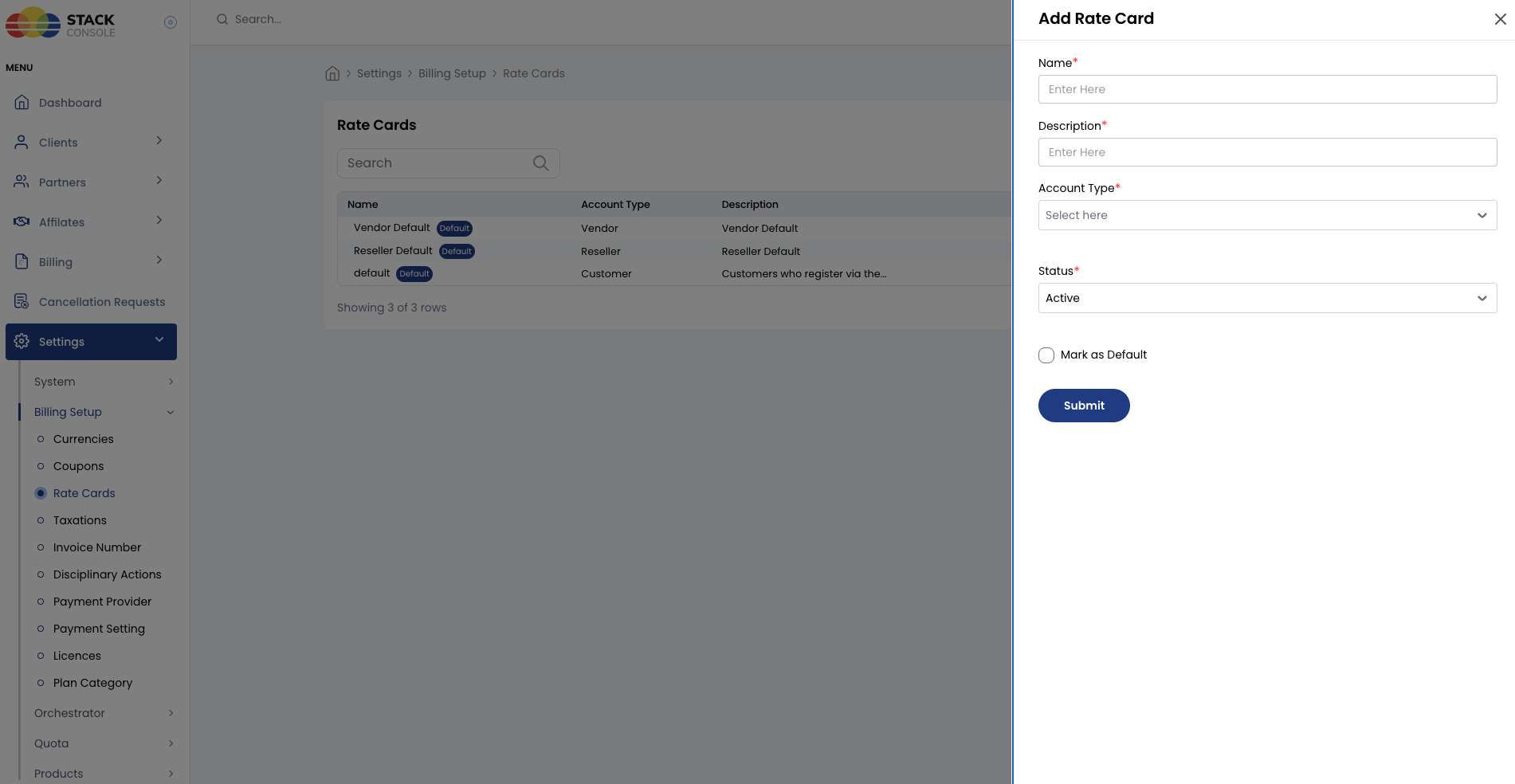
Each field below matches the Add Rate Card form.
Name
Required. Display name for the rate card — for example, Default, Enterprise Gold, or Acme Corp Pricing.
Description
Required. Short description of the rate card purpose — for example, Standard public pricing or Negotiated pricing for Acme Corp enterprise agreement.
Account Type
Required. Select which account type this rate card applies to — Customer, Reseller, or Vendor. Match the account type of accounts that will use this rate card.
Status
Required. Controls whether the rate card is available for assignment.
| Status | Behaviour |
|---|---|
| Active | Rate card can be assigned to customers and used for package configuration |
| Inactive | Hidden — use while configuring packages or retiring a rate card |
Mark as Default
Optional. When enabled, this rate card is automatically assigned to customers who self-register through the public registration form. Only one rate card should be marked as default at a time.
Configure packages on a rate card
After creating a rate card, add packages under:
Settings → Billing Setup → Rate Cards → [Rate Card Name] → Packages
Each package type (Virtual Machine, Volumes, IP Address, and so on) is configured separately. Orchestrator-specific guides below explain form fields and CloudStack prerequisites.
Many guides reference Rate Cards → Default → Packages as the example path. Replace Default with your rate card name when configuring customer-specific rate cards.
Orchestrator rate card guides
| Orchestrator | Status | Documentation |
|---|---|---|
| CloudStack (ACS) | ✅ Available | CloudStack Packages |
| OpenStack | 🔲 Coming soon | OpenStack — package documentation will be added in a future release |
| VMware vSphere | 🔲 Coming soon | VMware — package documentation will be added in a future release |
| Proxmox VE | 🔲 Coming soon | Proxmox — package documentation will be added in a future release |
| OpenNebula | 🔲 Coming soon | OpenNebula — package documentation will be added in a future release |
CloudStack package types
If you use CloudStack, see CloudStack Packages for the full list:
- Virtual Machine
- Virtual Router/VPC
- Load Balancer
- Kubernetes
- IP Address
- VM Autoscale
- Volumes
- Volumes Snapshot
- Template
- ISO
- VM Backup
- Unit Pricing
- Products
Validation checklist
Before marking a rate card Active and assigning it to customers:
- All required package types for your service catalogue are configured under this rate card
- Packages are set to Active with pricing for each supported currency and billing cycle
- Storage Settings and orchestrator prerequisites are complete (CloudStack zones, templates, offerings)
- Mark as Default is set on exactly one rate card if self-registration is enabled
- Enterprise rate cards are assigned to the correct accounts during admin onboarding