Postpaid
In postpaid mode, customers consume services first and pay invoices later. Saved payment methods can be auto-charged when invoices are due.
Postpaid is available only when both are true:
- The payment gateway natively supports automatic charging of credit cards for recurring payments with variable amounts (for example, Stripe)
- Has Autocharge is enabled for that provider in CMP (Settings → Billing Setup → Payment Provider)
Enabling Has Autocharge in CMP alone is not enough if the gateway does not support autocharge natively. See each gateway page (for example, Stripe — Payment Gateway Providers).
Use postpaid only with hourly and monthly billing cycles — not quarterly or longer.
| Risk | Why it matters |
|---|---|
| Revenue delay | Waiting months or years to collect on a long committed period |
| Fraud exposure | Customer can use services for the full cycle and leave before paying |
For quarterly and longer cycles, use prepaid or manual. See Billing Cycles — payment modes by cycle.
Set payment mode: Clients → Register Client (Step 2 — new onboarding) or Clients → [Customer] → Billing Setup (existing account)
Admin onboarding
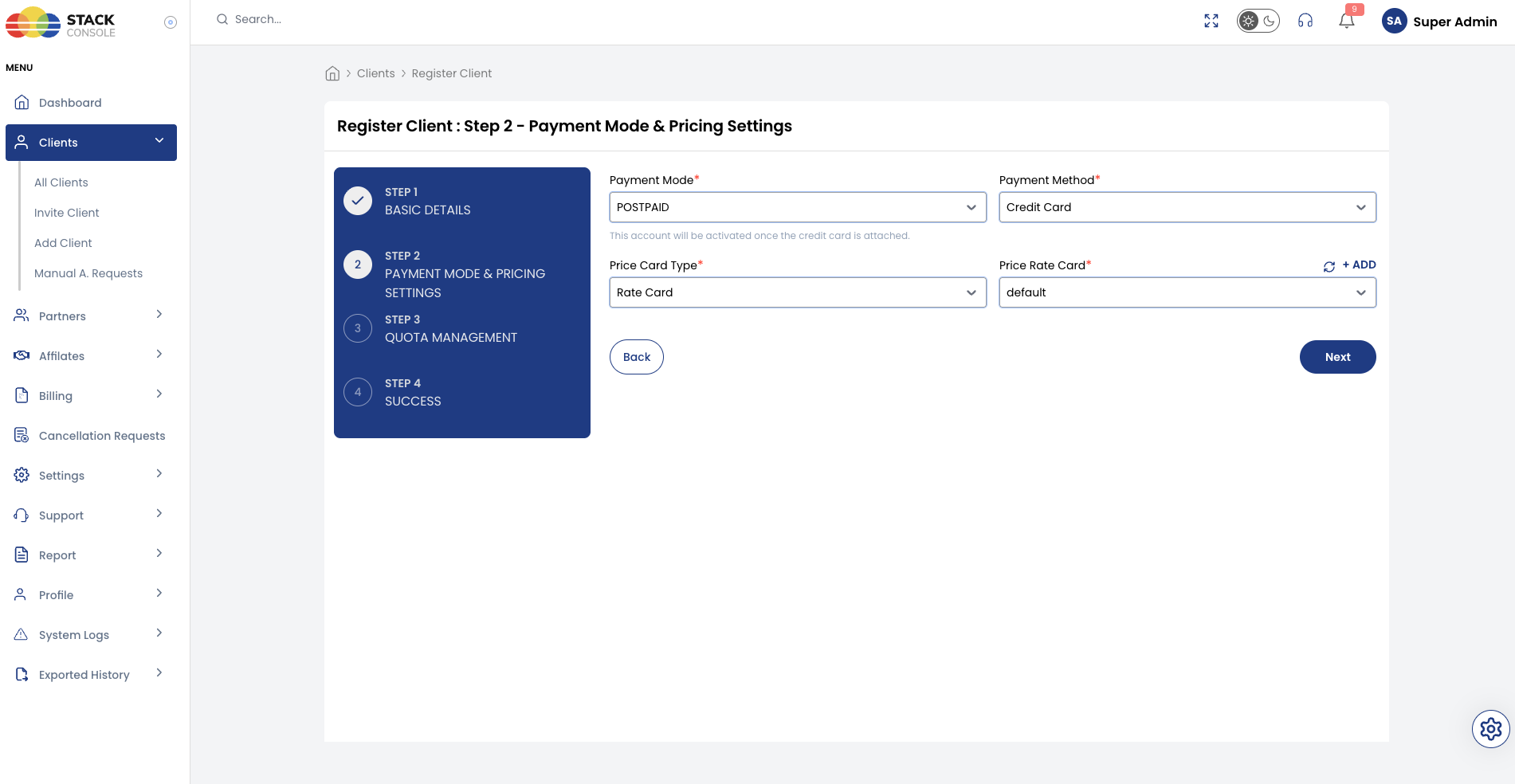
Admin selects POSTPAID when onboarding a customer via Clients → Register Client.
| Step | Action |
|---|---|
| 1 | Basic Details — enter customer information |
| 2 | Payment Mode & Pricing Settings — select POSTPAID, Payment Method (Credit Card), assign Price Rate Card |
| 3 | Quota Management — assign quotas |
| 4 | Success — customer must attach credit card to activate |
See Admin registration flow and Step 2 — Postpaid (admin).
Self-registration
Customers can select POSTPAID on the public signup form when postpaid is enabled for Customer in Payment Mode Settings. Modes marked Recommended show a badge on the form.
| Step | Action |
|---|---|
| 1 | Verify Email Address |
| 2 | Complete Payment — select POSTPAID, add and validate credit card |
Account activates once the customer attaches a saved card (requires gateway with Has Save Card and auto-charge support).
Billing cycles and postpaid
| Billing cycle | Use with postpaid? |
|---|---|
| Hourly | ✅ Recommended — usage consolidated monthly; threshold limits exposure |
| Monthly | ✅ Recommended — one billing period of outstanding exposure |
| Quarterly | ❌ Not recommended |
| Semi-annually | ❌ Not recommended |
| Annually | ❌ Not recommended |
| Bi-annually | ❌ Not recommended |
| Tri-annually | ❌ Not recommended |
Why quarterly and longer cycles do not fit postpaid:
- Revenue risk — you may wait many months or over a year before collecting payment for a committed period
- Fraud risk — a customer can provision long-cycle services, consume resources, and leave before an invoice is settled
Enable only hourly and monthly billing cycles for postpaid customers. Use prepaid or manual for quarterly and longer commitments. See Billing Cycles — payment modes by cycle.
| Rule | Behaviour |
|---|---|
| Service creation | Allowed until threshold is reached |
| Threshold breach | Invoice generated immediately + card auto-charge attempted |
| Monthly renewal | Invoices at month end; auto-charged to saved card |
| Failed charge | Retries daily per invoice_no_of_attempts → then Frozen |
Threshold (spending cap)
Threshold limits exposure before the normal billing period ends.
Configure:
- Global — per currency in Global Settings
- Account-level — override on individual customer in Billing Setup
Purpose
Postpaid customers can create services before paying. Threshold minimizes fraud risk by triggering early invoicing when usage reaches the cap.
Behaviour when threshold is reached
- System immediately generates an invoice (even if billing cycle has not ended)
- System attempts to collect payment from the saved payment method
- Threshold resets to 0 after invoice processing
- Customer can continue using services until threshold is reached again
Example:
- Customer ABC — postpaid, threshold $1,000
- Usage reaches $1,000 → invoice generated → auto-charge attempted → threshold reset
The same threshold concept applies to Manual accounts — but payment is offline and admin marks paid instead of auto-charge.
Service creation
CMP allows customers to create services as long as the defined threshold is not exceeded.
Service renewal
At the end of each month:
- Invoices generated based on actual usage
- Invoices automatically charged to the customer's saved card
Auto-charge failure workflow
Retry attempts
- System retries charging the card once per day
- Number of attempts controlled by global setting
invoice_no_of_attempts
Invoice frozen
If all retry attempts fail:
- Invoice marked Frozen
- Notifications sent to admin and customer
- Email templates:
FrozenInvoiceCustomerNotification,FrozenInvoiceAdminNotification
Handling frozen invoices
| Actor | Action |
|---|---|
| Admin | Verify with client → manually unfreeze invoice → system can process again |
| Customer | Open Invoice Details → attempt manual pay → on success, services continue |
Consolidated invoicing (one account, one invoice)
Postpaid deployments often require one consolidated invoice per billing cycle — not separate invoices per service event.
The DATE_TO_DATE billing rule does not support monthly consolidation.
Reason: Invoices are generated dynamically at the exact date/time each service is created — billing periods differ per service.
Example:
- Service A created on 5th → cycle runs 5th–5th
- Service B created on 12th → cycle runs 12th–12th
- Each service gets its own invoice
For consolidated monthly postpaid billing, use billing rules other than DATE_TO_DATE (for example, FIXED_PRORATA). See Billing Rules.
VM upgrade billing (postpaid)
Hourly services
| Period | Charging |
|---|---|
| Before upgrade | Original hourly rate — immediate invoice |
| After upgrade | New hourly rate to month end — included in month-end invoice |
Monthly and fixed cycles
Same proration logic as prepaid upgrades.
Postpaid upgrade invoicing:
- One invoice at end of billing period (e.g. 1st of next month)
- Multiple line items on that invoice — for example:
- Line 1: 1st–12th old plan = $39.36
- Line 2: 12th–30th upgrade adjustment = $29.52
Early deletion before cycle ends
| Billing cycle | Charge |
|---|---|
| Hourly | Actual usage from creation to deletion only |
| Fixed cycles | Full period charged — no refund. Admin may grant free credits for disputes |
Admin-created manual invoices
| Question | Answer |
|---|---|
| Auto-charge postpaid card immediately? | No |
| Who settles? | Admin marks paid, or customer pays manually in portal |
Admin-created manual invoices are not processed automatically by CMP.
Disciplinary actions and renewals
| Disciplinary state | Renewal invoices |
|---|---|
| Freeze | System continues creating renewal invoices |
| Suspend | System continues creating renewal invoices |
| Terminated | System does not create renewal invoices |
Full workflow: Disciplinary Actions.
Invoice settings (postpaid)
Postpaid invoice timing is controlled by flags in Admin → Invoices → Invoice Settings.
| Global setting | Purpose |
|---|---|
invoice_no_of_attempts | Days/attempts to retry failed card charges |
delay_due_date_in_days | Delay invoice due date (0 = immediate) |
Postpaid invoice generation modes
CMP supports two postpaid invoice generation approaches. Both are controlled by invoice settings flags — default is false for both.
| Flag | Default | When true | When false (default) |
|---|---|---|---|
POSTPAID_ADVANCE_PRO_RATA_INVOICE | false | A pro-rata payable invoice is generated immediately at service creation | Usage records are maintained during the cycle; charges are converted to a payable invoice on the next renewal. This cycle repeats |
POSTPAID_ADVANCE_INVOICE | false | The renewal payable invoice is generated on the 1st of the month (start of month) | Usage records are maintained during the cycle; charges are converted to a payable invoice on the next renewal. This cycle repeats |
Both flags default to false. If your deployment needs advance postpaid invoicing, decide this during initial system setup and inform StackConsole so the flags can be configured correctly.
Changing this behaviour after go-live is not supported. Mid-stream changes can break billing workflows and cause invoice inconsistencies for existing services.
Default mode (false — standard postpaid)
When both flags are false:
- CMP maintains usage records during the billing cycle
- On the next renewal, accumulated usage is converted to a payable invoice
- Auto-charge runs against the payable invoice
- The cycle repeats for each subsequent period
This is the behaviour most postpaid deployments use out of the box.
Advance mode (flags enabled)
When advance flags are enabled, CMP generates payable invoices immediately on the advance schedule instead of deferring conversion of usage records to payable invoices.
| Invoice type | When generated (advance mode) |
|---|---|
| Pro-rata invoice | Immediately at service creation |
| Renewal invoice | On the 1st of the month (start of month) — not at end of month |
Example — monthly billing cycle, service created 10 Jan 2026:
| Invoice | Generated | Covers period |
|---|---|---|
| Pro-rata | 10 Jan 2026 (immediately at creation) | 10 Jan – 31 Jan 2026 |
| Next renewal | 1 Feb 2026 (start of month) | 1 Feb – 28 Feb 2026 |
Advance postpaid invoicing uses the same timing as Manual advance invoice settings — pro-rata at creation, renewal on the 1st of the month. Only the flag names differ (POSTPAID_ADVANCE_* vs MANUAL_ADVANCE_*).
Only Manual → Postpaid is supported — it happens automatically when the customer saves a card. Prepaid and postpaid accounts cannot be converted to another payment mode. See Changing payment mode.